
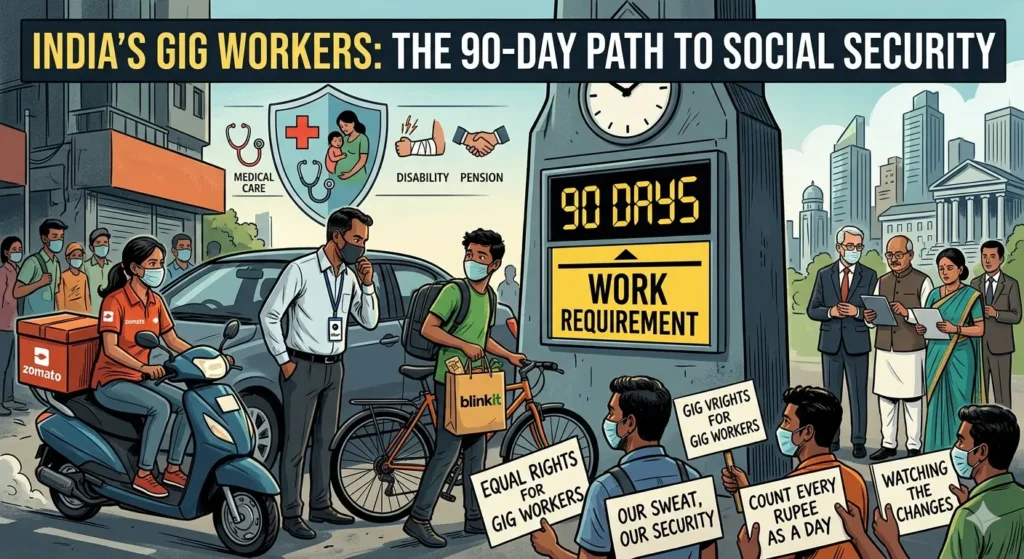
Will the 90 Days Rule for Gig Workers Change Gig Worker Benefits in India?
Imagine a food delivery rider working 10 hours a day, navigating traffic, extreme weather, and rising fuel costs. He delivers hundreds of orders every month, helping customers receive food quickly and conveniently. Yet unlike traditional employees, he often has no pension, limited insurance coverage, and little social security protection.
Now, a proposed “90-day rule” being discussed as part of India’s evolving gig worker welfare framework could become a major turning point.
Supporters say it could help ensure that genuine and active platform workers receive important social security benefits. Critics argue that it may exclude part-time workers and those who work across multiple platforms.
As India’s gig economy continues to expand rapidly, the question many workers are asking is simple:
Will the 90-day rule improve gig worker benefits, or create new barriers to welfare access?
Let’s break it down.
What Benefits Could Gig Workers Receive after 90 Days Rule for Gig Workers ?
If social security measures expand as expected, eligible workers may gain access to several important protections
- Home-service apps
- Freelance digital marketplaces
These workers provide essential services to consumers and businesses, yet many remain outside the traditional social security system available to salaried employees.
Unlike regular employees, most platform workers generally do not receive:
- Employer-funded pension benefits
- Comprehensive health insurance
- Paid leave
- Gratuity
- Long-term retirement support. 1. Health Insurance
Medical emergencies can create severe financial stress for gig workers.
Expanded insurance coverage could help workers and their families manage hospitalization and treatment costs.
2. Accident Insurance
Delivery riders and drivers face daily road risks.
Accident insurance could provide compensation for injuries sustained while working.
3. Disability Support
Serious accidents can impact a worker’s ability to earn income.
Disability-related benefits could offer financial assistance during recovery.
4. Pension and Retirement Security
Many gig workers currently lack retirement planning support.
Future social security schemes may include pension-related provisions designed to provide long-term financial stability.
5. Maternity and Family Benefits
Female platform workers could potentially gain access to welfare measures supporting maternity and family care.
6. Skill Development Programs
Government-supported training programs could help workers improve skills and access higher-income opportunities.
How the 90-Day Rule Could Benefit Workers - Supporters believe the proposal offers several advantages.
- Better Targeting of Welfare Funds
- Social security funds are limited.
- Eligibility requirements may help ensure benefits reach workers who rely on gig work as a primary source of income.
- Reduced Misuse
- The rule may discourage inactive registrations and improve the efficiency of welfare programs.
- Clear Eligibility Standards
- A structured system can provide greater clarity for workers, platforms, and regulators.
- Stronger Recognition of Gig Work
- Formal eligibility standards may help integrate gig workers more effectively into India’s social security ecosystem
Why Some Worker Groups Are Concerned about the 90 Days Rule for Gig Workers?
Not everyone is convinced that the rule will benefit all workers equally.
Part-Time Gig Workers May Be Excluded
Many individuals use gig platforms to earn supplementary income.
Students, homemakers, and part-time workers may struggle to meet eligibility requirements.
Multi-Platform Workers Could Face Complications
Many workers earn income from multiple apps, such as:
- Swiggy
- Zomato
- Uber
- Rapido
- Porter
Tracking eligibility across several platforms could become complicated if systems are not integrated properly.
Seasonal Workers Could Miss Out
Many workers join platforms during festivals, holidays, or peak demand periods.
These workers may not meet minimum activity thresholds despite contributing significantly during busy seasons.
What Does the Rule Mean for Companies?
The proposed framework may also affect platform companies.
Potential responsibilities could include:
- Worker registration
- Data reporting
- Contributions to welfare funds
- Compliance with social security regulations
While this may increase compliance costs, it could also improve:
- Worker retention
- Platform reputation
- Workforce stability
- Public trust
Companies that proactively support worker welfare may gain competitive advantages in the long run.
Who Stands to Benefit the Most?
Likely Winners
✔ Full-time delivery partners
✔ Active ride-hailing drivers
✔ Long-term platform workers
✔ Workers dependent on gig income
✔ Registered workers with consistent activity levels
Who Could Face Challenges?
✔ Casual gig workers
✔ Seasonal workers
✔ Part-time workers
✔ Individuals working sporadically
✔ Workers whose activity is spread across multiple apps
Why This Matters for India’s Gig Economy
India is one of the world’s fastest-growing gig economy markets.
The way policymakers design social security protections today could influence:
- Worker welfare
- Platform business models
- Employment opportunities
- Labour regulations
- Future digital economy growth
The challenge will be finding the right balance between worker protection and operational flexibility.
What Happens Next?
The regulatory framework is still evolving.
Before final implementation, stakeholders including:
- Government agencies
- Platform companies
- Worker associations
- Labour experts
are expected to continue consultations.
The final rules may differ from currently discussed proposals as policymakers seek practical solutions that balance competing interests.
Conclusion
The proposed 90-day rule could become one of the most significant developments in India’s gig economy.
For millions of delivery riders, drivers, and platform workers, it represents the possibility of long-awaited social security protections. At the same time, concerns remain about whether eligibility requirements could unintentionally exclude part-time and seasonal workers.
The ultimate success of the policy will depend on how effectively it balances inclusion, worker welfare, and administrative practicality.
One thing is clear: India’s gig economy is entering a new era, and the decisions made today could shape the future of work for millions of workers across the country.
Frequently Asked Questions (FAQs)
What is the 90-day rule for gig workers in India?
The proposed rule suggests that workers may need to complete a minimum activity threshold, often reported as around 90 working days, to qualify for certain welfare and social security benefits.
Will all gig workers receive benefits under the new rule?
Not necessarily. Eligibility may depend on meeting activity requirements and other conditions specified in final regulations.
Which workers may benefit most from the rule?
Full-time delivery partners, ride-hailing drivers, and workers who depend primarily on gig platforms for income may benefit the most.
Can part-time gig workers be affected?
Some labour experts and worker groups have expressed concerns that part-time or seasonal workers could find it more difficult to qualify.
What types of benefits could become available?
Potential benefits include health insurance, accident coverage, disability support, pension-related benefits, maternity support, and skill development programs.
About the Author
Business Zindagi Editorial Team covers MSMEs, startups, entrepreneurship, government policies, labour reforms, technology, finance, and business trends that impact Indian entrepreneurs and working professionals.
This topic is a very good fit for BusinessZindagi.com because it combines current news, MSME advice, exports, business strategy, and government policy. It can attract readers from Google Search, Google Discover, and LinkedIn.
✔ Maintain emergency funds
✔ Reduce dependency on one customer
✔ Use technology
✔ Explore exports
✔ Monitor costs monthly
Conclusion
End positively:
Ok write the article as planned above with authentic sources and references link at the end. Create a detailed businesszindagi.com style article with all sections
Here’s a detailed BusinessZindagi-style article draft you can publish and further customize.
The MSME sector contributes significantly to India’s economy, employment generation, manufacturing output, and exports. As uncertainty continues to affect global trade, India’s small businesses are proving that flexibility and innovation can become powerful survival tools.
What Is Driving Global Economic Uncertainty In 2026?
Several factors are creating instability across international markets:
Geopolitical Conflicts
Ongoing tensions in West Asia have disrupted global shipping routes, increased freight costs, and pushed up energy prices. Businesses dependent on imported raw materials are facing higher operating expenses.
Supply Chain Disruptions
Global supply chains remain vulnerable to political tensions, transportation bottlenecks, and changing trade policies. Delays in sourcing raw materials continue to affect manufacturing industries.
Inflation And Rising Costs
Fuel prices, transportation expenses, packaging materials, and imported components have become more expensive, directly impacting small businesses.
Currency Volatility
The weakening of several currencies against the US dollar has increased the cost of imports for many businesses while also creating uncertainty in international trade transactions.
According to industry bodies, many MSMEs have experienced increased production costs because of higher fuel prices, imported input costs, and global trade disruptions.
How Indian MSMEs Are Surviving In 2026
Despite these difficulties, Indian MSMEs are not standing still. Many are implementing practical strategies to improve resilience.
1. Diversifying Export Markets
One of the biggest lessons from recent global disruptions is the danger of depending too heavily on a single export destination.
Many Indian exporters are increasingly exploring opportunities in:
- Middle Eastern countries
- Africa
- Southeast Asia
- Emerging markets
This diversification helps reduce dependence on any one region while creating new growth opportunities.
Several export-focused MSMEs are benefiting from global supply-chain realignments as international buyers look for alternatives to traditional manufacturing hubs.
2. Strengthening Supply Chain Resilience
Supply chain disruptions have encouraged businesses to rethink sourcing strategies.
MSMEs are now:
- Building relationships with multiple suppliers
- Increasing local sourcing
- Maintaining safety inventories
- Reducing dependence on a single country for critical inputs
Businesses that invested in supply-chain resilience during earlier disruptions are now better positioned to manage current uncertainty.
3. Accelerating Digital Transformation
Technology adoption is becoming one of the strongest survival tools for Indian MSMEs.
Small businesses are increasingly using:
- Cloud accounting software
- Digital payment systems
- E-commerce platforms
- Customer relationship management tools
- Artificial intelligence solutions
Digital transformation helps businesses improve efficiency, reduce costs, and access wider customer markets.
The growing penetration of digital infrastructure in Tier-2 and Tier-3 cities is also creating new opportunities for entrepreneurs outside major metropolitan areas.
4. Improving Operational Efficiency
Many MSMEs are focusing on cost control rather than aggressive expansion.
Businesses are investing in:
- Process automation
- Energy-efficient equipment
- Better inventory management
- Lean manufacturing practices
These improvements help protect profit margins even during periods of economic uncertainty.
5. Leveraging Government Support Schemes
Government initiatives continue to play an important role in supporting the MSME ecosystem.
Recent measures include:
- Expanded MSME financing support
- Credit guarantee programs
- Technology upgrade assistance
- Export promotion initiatives
- Emergency credit support mechanisms
The government’s continued focus on strengthening MSME competitiveness is expected to help small businesses manage economic volatility more effectively.
New Opportunities Emerging From Global Uncertainty
Interestingly, uncertainty is also creating opportunities for Indian businesses.
The China+1 Strategy
Many global companies are diversifying manufacturing operations beyond China.
India is emerging as a major beneficiary of this shift, creating opportunities for MSMEs involved in:
- Manufacturing
- Electronics
- Engineering goods
- Auto components
- Textiles
Growing Demand For Local Manufacturing
Governments and businesses worldwide are emphasizing supply-chain security and local production.
This trend supports initiatives such as:
- Make in India
- Production-linked incentives
- Domestic manufacturing expansion
Digital Exports And Services
Technology has enabled even small businesses to access international customers.
Digital services, software solutions, consulting, design services, and online commerce are creating new export opportunities for Indian entrepreneurs.
Lessons Small Business Owners Can Learn In 2026
Businesses that are surviving successfully share several common characteristics.
Maintain Strong Cash Flow
Cash flow remains the lifeline of every small business. Maintaining adequate liquidity can help companies withstand temporary disruptions.
Avoid Customer Concentration Risk
Depending on a single large customer can create significant vulnerability.
Invest In Technology
Technology investments often improve productivity and reduce long-term operating costs.
Build Flexible Supply Chains
Supplier diversification reduces business risk during disruptions.
Monitor Costs Continuously
Businesses that closely track expenses can respond faster to changing market conditions.
Explore New Markets
Expanding into new regions or customer segments can reduce dependence on slowing markets.
Why The Future Still Looks Positive For Indian MSMEs
Although global economic uncertainty remains a concern, India’s long-term economic fundamentals remain relatively strong.
Several factors support future MSME growth:
- Large domestic market
- Expanding digital economy
- Government support initiatives
- Growing manufacturing ecosystem
- Rising entrepreneurship in smaller cities
- Increasing global interest in India as a production hub
Many experts believe that businesses focusing on innovation, efficiency, and adaptability will emerge stronger from the current period of uncertainty.
Conclusion
Global economic uncertainty is creating challenges for businesses across the world, but Indian MSMEs are demonstrating remarkable resilience in 2026.
By diversifying export markets, strengthening supply chains, adopting digital technologies, improving efficiency, and leveraging government support, many small businesses are turning challenges into opportunities.
While risks remain, the MSME sector continues to be one of India’s strongest economic pillars. Businesses that embrace adaptability and strategic planning may not only survive the current uncertainty but also position themselves for long-term growth in the years ahead.
Frequently Asked Questions (FAQs)
What are the biggest challenges facing Indian MSMEs in 2026?
Major challenges include rising input costs, supply chain disruptions, geopolitical tensions, inflation, export uncertainties, and limited access to affordable financing.
How are Indian MSMEs adapting to global economic uncertainty?
Many MSMEs are diversifying export markets, adopting digital technologies, improving operational efficiency, and strengthening supply chain resilience.
What opportunities are available for MSMEs in 2026?
Opportunities include the China+1 manufacturing shift, digital exports, local manufacturing growth, and increasing demand from emerging markets.
How important is digital transformation for MSMEs?
Digital transformation helps businesses improve efficiency, reduce costs, expand customer reach, and compete more effectively in a challenging environment.
What government support is available for MSMEs?
Support includes credit guarantee schemes, financing programs, export promotion initiatives, technology support, and emergency credit assistance.
About The Author
Business Zindagi Editorial Team covers entrepreneurship, MSMEs, startups, business trends, government policies, technology, and financial developments that impact Indian businesses and entrepreneurs.
AI Disclosure
This article was researched and drafted with the assistance of AI tools and editorial review. Information has been verified using publicly available sources wherever possible. Readers are advised to consult official government notifications and professional advisors before making business decisions.
Sources & References
- Times of India – Amid turmoil, MSMEs look to adapt
- PIB – Union Budget 2026-27: Building Champion MSMEs
- Economic Times – India’s exporters are winning. The money hasn’t caught up
- Economic Times – FM Sitharaman launches key SIDBI initiatives for MSME growth
- Drishti IAS – West Asia War & India’s Manufacturing Slowdown
- OECD – Financing SMEs and Entrepreneurs 2026
Key facts in this article are supported by recent reporting and official policy updates.
“Will the 90-Day Rule Change Gig Worker Benefits in India?” How can I write a helpful and interesting content on the above topic
This topic has strong potential because it combines breaking policy developments, gig workers, social security, labour reforms, and practical impact, which can attract readers from Google News, Discover, and Search.
The biggest mistake would be writing it as a legal article. Instead, write it as a “What does this mean for millions of delivery partners, drivers, and platform workers?” article.
Best Focus Keyword
90-day rule gig workers India
Secondary Keywords
- gig worker benefits India
- social security for gig workers
- platform workers benefits
- gig worker rules 2026
- delivery partner benefits
- Swiggy delivery partner
- Zomato delivery partner
- Uber driver benefits
- labour code India
- gig economy India
- social security code
- e-Shram registration
- platform workers welfare
- gig workers social security fund
Winning Angle For BusinessZindagi.com
Instead of focusing on legal language, focus on the real-world question:
“Will food delivery riders, cab drivers and online platform workers finally receive meaningful social security benefits—or will the proposed 90-day eligibility rule leave many workers out?”
This creates curiosity and emotional engagement.
Suggested Article Structure
Introduction
Start with a relatable example:
Imagine a food delivery rider working long hours for multiple apps. He delivers hundreds of orders every month but still lacks health insurance, pension protection, or social security benefits. India’s proposed 90-day rule could change that—but not everyone is convinced it will help all gig workers.
Then explain:
- What the 90-day rule is
- Why it matters
- Why millions of workers are watching closely
What Is The 90-Day Rule?
Explain simply.
For example:
The proposed framework suggests that platform workers may need to complete a minimum work threshold (often discussed as around 90 working days during a specified period) to qualify for certain welfare and social security benefits.
Mention that final implementation details may still evolve.
Why Is India Introducing This Rule?
Explain the background.
India’s gig economy has grown rapidly.
Workers include:
- Food delivery riders
- Cab drivers
- Courier partners
- Freelance platform workers
- Home service professionals
Most do not receive traditional employee benefits.
The government aims to:
- Create social security coverage
- Improve worker welfare
- Formalize the gig economy
What Benefits Could Gig Workers Receive?
This is where readers become interested.
Possible benefits being discussed include:
Health Insurance
Coverage for medical emergencies.
Accident Insurance
Protection against injuries while working.
Disability Benefits
Financial support after serious accidents.
Pension Support
Long-term retirement security.
Maternity Benefits
Support for eligible female workers.
Skill Development Programs
Training opportunities for career growth.
How Could The 90-Day Rule Help Workers?
Positive arguments.
Prevents Fraudulent Registrations
Ensures active workers receive benefits.
Creates Clear Eligibility Standards
Platforms and governments can identify genuine workers.
Better Targeting Of Welfare Funds
Benefits can reach those actively participating in gig work.
Why Some Worker Groups Are Concerned
This is the most interesting section.
Part-Time Workers May Lose Out
Many workers use gig platforms only occasionally.
They may fail to meet eligibility requirements.
Multiple Platform Workers
Some workers divide their time between:
- Swiggy
- Zomato
- Uber
- Rapido
Tracking eligibility may become complicated.
Seasonal Workers
Workers who join only during festivals or high-demand periods may not qualify.
What Could This Mean For Companies?
Discuss business impact.
Platforms may face:
- New compliance requirements
- Contribution obligations
- Higher operational costs
However, benefits include:
- Better worker retention
- Improved platform reputation
- More stable workforce
What Experts Are Saying
Include viewpoints from:
- Labour economists
- Worker unions
- Industry bodies
Present both sides fairly.
Who Wins And Who May Lose?
Likely Winners
✔ Full-time delivery riders
✔ Active cab drivers
✔ Long-term platform workers
✔ Workers dependent on gig income
Potential Challenges
✔ Occasional workers
✔ Seasonal workers
✔ Workers using multiple apps
What Happens Next?
Explain:
- Draft rules
- Stakeholder consultations
- Final notification process
- Expected implementation timeline
Conclusion
End with a balanced thought:
The proposed 90-day rule could become one of the most significant changes in India’s gig economy. If implemented effectively, it may bring social security benefits to millions of workers who have long operated without protection. However, policymakers will need to ensure that eligibility requirements do not unintentionally exclude the very workers the reforms are designed to help.
Most importantly, it answers a practical question rather than simply reporting the news, which is exactly the type of helpful content that tends to perform better on BusinessZindagi.com.
Will the 90-Day Rule Change Gig Worker Benefits in India? What Delivery Riders, Drivers and Platform Workers Need to Know
Sources & References
- Reuters – UN Labour Agency Discusses Employment Standards for Gig Workers
Reuters Gig Worker Standards Report - Ministry of Labour & Employment (Government of India)
Ministry of Labour & Employment - e-Shram Portal
e-Shram Official Portal - Code on Social Security, 2020
Code on Social Security 2020 - NITI Aayog Report on India’s Gig Economy
NITI Aayog Gig Economy Report