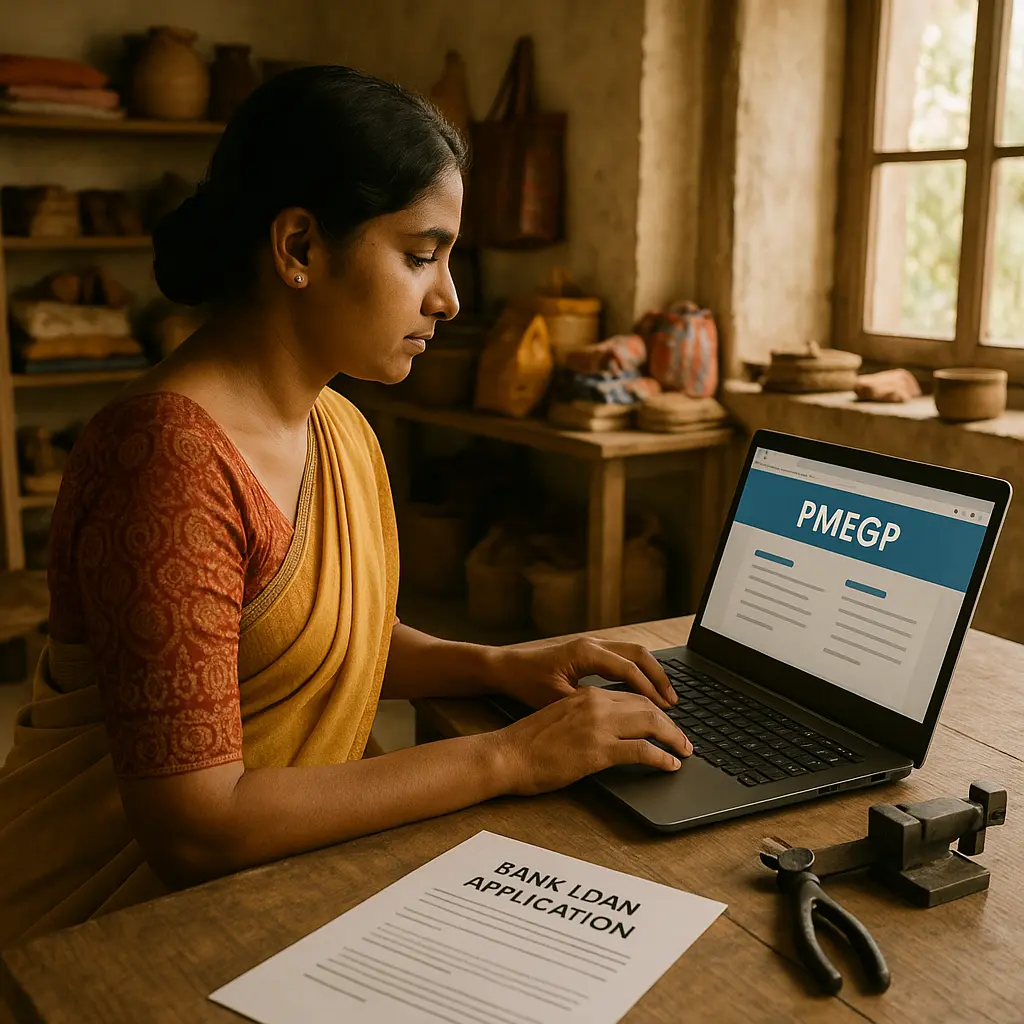
Starting a business in India is exciting. But for most first-time entrepreneurs, the biggest obstacle appears even before the business begins — money.
Many people have business ideas:
- a small manufacturing unit,
- a cloud kitchen,
- a bakery,
- a mobile repair shop,
- a food processing business,
- or a local service startup.
But without financial support, those ideas often remain only dreams.
This is where the PMEGP Scheme becomes important.
The Prime Minister’s Employment Generation Programme (PMEGP) is one of India’s biggest government-backed business support schemes designed to help small entrepreneurs start new businesses with subsidy support.
In recent years, the scheme has become especially important for:
- MSMEs,
- rural entrepreneurs,
- women entrepreneurs,
- unemployed youth,
- and first-time business owners.
However, despite its popularity, many people still misunderstand how the PMEGP scheme actually works. Some believe it is an “easy government loan,” while others apply without proper planning and later face rejection.
So in this detailed guide, let us understand the PMEGP Scheme in a practical and realistic way.
What is PMEGP Scheme?
The PMEGP Scheme stands for Prime Minister’s Employment Generation Programme.
It is a government subsidy-linked business loan scheme implemented by:
- Khadi and Village Industries Commission (KVIC),
- District Industries Centres (DIC),
- and State Khadi Boards.
The main goal of the scheme is simple:
help people start small businesses and create employment opportunities.
Under PMEGP:
- banks provide business loans,
- while the government provides subsidy support known as margin money subsidy.
This reduces the financial burden on new entrepreneurs.
Official Portal:
PMEGP Official Website
Why PMEGP Scheme Matters More in 2026
India’s MSME sector is growing rapidly. At the same time, unemployment and startup funding challenges still exist for many small entrepreneurs.
This is one reason the government continues to focus strongly on PMEGP.
In 2026, the scheme remains highly relevant because:
- manufacturing businesses are receiving more attention,
- rural entrepreneurship is growing,
- local production is being encouraged,
- and small businesses are becoming important for employment generation.
The scheme is now seen not just as a loan program, but as a tool for local economic development.
What’s New in PMEGP Scheme 2026?
Several important developments have made the PMEGP scheme more attractive in recent years.
Higher Project Limits
The government has increased project cost limits significantly.
| Sector | Maximum Project Cost |
|---|---|
| Manufacturing | ₹50 lakh |
| Service Sector | ₹20 lakh |
This allows entrepreneurs to think beyond extremely small setups.
Subsidy Benefits Still Attractive
One of the biggest reasons people apply for PMEGP is the subsidy support.
| Category | Urban Area | Rural Area |
|---|---|---|
| General Category | 15% | 25% |
| Special Category (SC/ST/OBC/Women/Minority/NE Region etc.) | 25% | 35% |
For entrepreneurs in rural areas and Northeast India, the subsidy can become a major advantage.
Online Application Process Improved
The PMEGP application system is now largely online.
Applicants can:
- apply online,
- upload documents,
- track applications,
- and access project reports digitally.
Apply Online Here:
PMEGP Online Application Portal
The Reality Most Applicants Discover Late
Many people think:
“Government scheme hai… loan easily mil jayega.”
But the reality is very different.
Banks today are much more careful while approving PMEGP applications.
In 2026, approval depends heavily on:
- your project report,
- business understanding,
- market demand,
- repayment capacity,
- and overall business viability.
A poorly prepared application can easily get rejected.
This is why serious preparation matters more than ever.
Why Many PMEGP Applications Get Rejected
This is one of the most important things people should understand before applying.
Common rejection reasons of PMEGP loan may include:
- unrealistic business plans,
- copied project reports,
- incomplete documentation,
- weak market research,
- poor communication with bank officials,
- or selecting businesses with unclear profitability.
In many cases, applicants apply simply because they heard about subsidy benefits — without understanding the business itself.
Banks are now focusing more on sustainable businesses rather than only paperwork.
Not sure which MSME government scheme you may qualify for? Use the BusinessZindagi MSME Scheme Eligibility Checker to check your basic eligibility across relevant schemes.
MSME Scheme Eligibility Checker Pro
Answer 8 simple questions to discover Government schemes that may fit your business profile. Takes about 60 seconds.
Free ToolBusiness Type
Select the option that best describes your business.
Business Stage
Business Registration
This helps the checker narrow down schemes without asking for sensitive information.
Entity Type
Investment
Loan Requirement
Business Location
Special Category
Optional. You can select more than one if applicable.
Export Interest
Your MSME Scheme Profile
This is a rule-based profile match, not an official eligibility decision.
Potential Scheme Matches
We show the most relevant matches first. Verify current rules with the official source before applying.
Personalised Action Plan
Prepare These Documents
- ✔ Aadhaar
- ✔ PAN
- ✔ Address Proof
- ✔ Bank Account
- ✔ Udyam
- ✔ GST
- ✔ Project Report
- ✔ Quotations
- ✔ IEC (if exporting)
What is MSME Scheme Eligibility Checker?
An educational tool that maps your business profile to popular Central Government schemes for MSMEs, startups and exporters. It suggests schemes you may be eligible for — it is not an official Government checker.
How It Works
Answer eight short questions about type, stage, entity, investment, loan need, location, special category and export interest. The tool scores readiness and lists schemes that often align with similar profiles.
Frequently Asked Questions
Is this an official Government tool?
No. It provides general guidance only. Final eligibility is decided by the concerned ministry, bank or implementing agency.
What is PMEGP?
Prime Minister’s Employment Generation Programme supports new micro enterprises with margin money subsidy through KVIC/KVIB/DIC.
What is Mudra Loan?
Loans under PMMY for non-farm micro enterprises — Shishu, Kishore and Tarun categories up to ₹10 lakh (limits may be revised).
Do I need Udyam registration?
Udyam is strongly recommended for most MSME benefits and is free online.
Can startups use this?
Yes. Startup India and related benefits may appear if your profile matches.
Are results guaranteed?
No. Always read official guidelines and consult a bank or consultant before applying.
Related Tools
Related Guides
Disclaimer: This tool provides general guidance only. It does not confirm eligibility, approval, subsidy or loan sanction. Actual eligibility depends on current official notifications, scheme guidelines and the implementing agency or lender.
Which Businesses Are Getting Better Attention Under PMEGP?
Some business categories are currently receiving strong attention because they generate local employment and support manufacturing or services.
Popular PMEGP business ideas in 2026 include:
- cloud kitchens,
- food processing units,
- bakery businesses,
- dairy and poultry,
- digital printing,
- garment manufacturing,
- spice grinding,
- mobile repair businesses,
- eco-friendly packaging,
- paper products,
- furniture units,
- local manufacturing businesses.
Businesses connected to local production and rural development often receive better support.
PMEGP Scheme for Women Entrepreneurs
Women entrepreneurship is becoming an important focus area under PMEGP.
Women applicants can receive:
- higher subsidy benefits,
- lower own contribution requirements,
- and support for home-based and rural businesses.
Many women entrepreneurs are now starting:
- tailoring businesses,
- food businesses,
- beauty services,
- handicrafts,
- cloud kitchens,
- and small manufacturing units through PMEGP support.
PMEGP Scheme for Rural India
The scheme is especially valuable for rural entrepreneurs.
Why?
Because many rural businesses struggle to get traditional business funding.
PMEGP helps rural entrepreneurs start:
- agro-based businesses,
- dairy businesses,
- food processing units,
- village industries,
- and small manufacturing units.
This not only creates self-employment but also generates local jobs.
How to Increase PMEGP Loan Approval Chances
If you are serious about applying under PMEGP, preparation matters a lot.
Some practical tips:
- prepare a realistic project report,
- understand your market properly,
- avoid exaggerated profit projections,
- maintain proper documentation,
- learn basic business operations,
- and communicate professionally with the bank.
Applicants who appear serious and well-prepared usually create better confidence for lenders.
Biggest Challenges in PMEGP Scheme
Although PMEGP is beneficial, applicants still face several practical problems:
- bank processing delays,
- repeated verification,
- subsidy release delays,
- lack of guidance,
- and inconsistent responses from local branches.
This is why understanding the process realistically is very important before applying.
Is PMEGP Scheme Still Worth It in 2026?
For many entrepreneurs, yes.
Especially for:
- first-time business owners,
- rural entrepreneurs,
- women entrepreneurs,
- small manufacturers,
- and service startups.
However, PMEGP should not be viewed as “free money.”
It works best for people who:
- genuinely want to build a business,
- understand their market,
- and are prepared to run the business seriously.
For such entrepreneurs, PMEGP can become a powerful starting point.
Final Thoughts
The PMEGP Scheme continues to remain one of India’s most important business support schemes for MSMEs and small entrepreneurs.
But success under the scheme no longer depends only on filling an application form.
In 2026, successful applicants are usually those who:
- prepare professionally,
- choose practical business ideas,
- understand market realities,
- and approach the scheme seriously.
For entrepreneurs willing to plan properly and work consistently, PMEGP can still become a life-changing opportunity.
Frequently Asked Questions (FAQ)
What is the maximum loan amount under PMEGP scheme?
The maximum project cost allowed is:
- ₹50 lakh for manufacturing businesses
- ₹20 lakh for service businesses
What is the maximum subsidy under PMEGP?
Subsidy can go up to 35% depending on category and location.
Can existing businesses apply for PMEGP?
No. PMEGP is mainly designed for new business ventures.
Is collateral required for PMEGP loan?
Collateral requirements depend on bank policies and RBI guidelines.
Which businesses have higher approval chances?
Manufacturing, food processing, local employment-generating businesses, and rural industries often receive better support.
Is PMEGP available in 2026?
Yes. The PMEGP scheme continues to operate actively in 2026.
Authentic Sources & References
- KVIC PMEGP Official Portal
- PMEGP Online Application Portal
- Ministry of MSME, Government of India
- Press Information Bureau (PIB) India
- SIDBI Official Website
- Udyam Registration Portal
About the Author
Tabrez Khan is the founder and writer behind Business Zindagi, a platform focused on MSMEs, startups, entrepreneurship, government schemes, business finance, and practical business awareness for Indian entrepreneurs.
He regularly writes about:
- small business opportunities,
- MSME schemes,
- startup trends,
- government policies,
- and practical business challenges affecting entrepreneurs in India.
His writing style focuses on simplifying complex business topics into practical and easy-to-understand insights for everyday readers.
AI Transparency Disclaimer
This article was created with research support and AI-assisted drafting, followed by human editing and contextual improvements for readers of Business Zindagi.