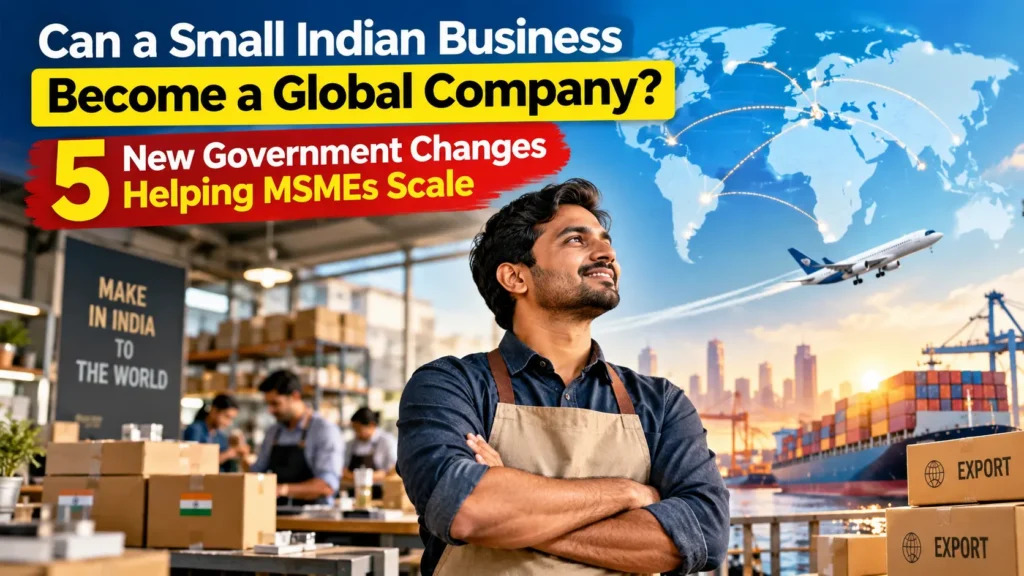
A small factory in a Tier-II city.
A family-run trading business.
A food manufacturer selling mainly in its own state.
A technology startup with a good product but limited capital.
Could any of these businesses become a ₹100-crore or even a global company?
For years, one of the biggest problems facing Indian MSMEs has not been starting a business. It has been scaling one.
A business may have customers but not enough capital. It may have orders but its money may be stuck in receivables. It may have a competitive product but no overseas buyers. And even when the opportunity is there, the entrepreneur may hesitate to take on more debt.
Something important is changing in 2026.
The government is increasingly shifting its MSME focus from simply supporting small businesses to helping promising businesses scale, become more competitive and enter global markets.
The biggest example is the newly approved ₹10,000 crore SME Growth Fund.
But that is only one part of the story.
Here are five changes that could make the next phase of Indian MSME growth very different.
1. The ₹10,000 Crore SME Growth Fund Could Change How Growing Businesses Raise Capital
This is the biggest headline.
On 6 October 2026, the Union Cabinet approved the government’s commitment of ₹10,000 crore towards the SME Growth Fund.
The purpose is not simply to provide another business loan.
The fund is designed to provide growth-oriented equity capital to high-potential small and medium enterprises with demonstrated viability and scalability.
The government says the fund will help businesses:
- Expand manufacturing capacity
- Adopt advanced technology
- Scale operations
- Enter international markets
- Integrate into global value chains
- Undertake strategic investments and acquisitions
A majority of the fund is expected to be directed towards small and medium manufacturing enterprises, while SMEs operating in industrial clusters in Tier-II and Tier-III cities can also be considered. Press Information Bureau
Why is equity important?
Imagine a manufacturing company that has annual sales of ₹20 crore.
It has a good product and customers, but wants to invest ₹5 crore in machinery and expansion.
Taking the entire amount as debt means additional interest and repayment obligations.
Equity is different.
Instead of simply borrowing money, the business receives investment in exchange for an ownership interest.
That makes the SME Growth Fund particularly interesting for growth-stage businesses, rather than someone looking for a small working-capital loan.
The government itself identifies a gap in long-term risk capital for SMEs wanting to scale, innovate and expand internationally. Press Information Bureau
The important question for entrepreneurs
Don’t ask:
“How can I get the ₹10,000 crore?”
Ask:
“Is my business becoming the kind of company that investors would want to invest in?”
That means building proper accounts, predictable revenue, healthy margins, scalable operations and a credible expansion plan.
If you are comparing different ways of financing a business, see our guide to 7 MSME Funding Options in India.
2. MSME Payment Problems Are Finally Getting More Attention
Here’s a problem every growing entrepreneur understands:
You make the sale today. You may receive the money months later.
Meanwhile, your suppliers want payment.
Your employees need salaries.
Your bank wants its EMI.
You need raw materials for the next order.
This is why cash flow can be more important than sales.
The 2026 MSMED reforms address this problem through stronger mechanisms for delayed payments and greater use of TReDS — Trade Receivables Discounting System.
The amended framework provides for Online Dispute Resolution and faster mechanisms for dealing with delayed-payment disputes. It also requires Central Public Sector Enterprises to route settlement of invoices for MSME purchases through TReDS. Press Information Bureau
The scale of TReDS has also increased dramatically.
According to the Ministry of MSME, invoice discounting through TReDS increased from about ₹40,000 crore in 2022-23 to ₹3.47 lakh crore in 2025-26. Press Information Bureau
Why should an entrepreneur care?
Suppose your company supplies ₹25 lakh of goods to a large buyer.
The buyer’s payment cycle is 60 days.
If that receivable can be financed through TReDS, you may be able to access working capital earlier instead of waiting for the entire 60-day period.
That can mean:
Faster cash → more production → more orders → faster growth.
The 2026 Budget also proposed additional measures around TReDS, including CGTMSE-backed credit support for invoice discounting and integration with GeM. Press Information Bureau
You can read our practical guide to TReDS for MSMEs.
3. India’s Small Businesses Are Being Given a Bigger Reason to Think Global
For a long time, exporting was often seen as something only large manufacturers could do.
That is changing.
Indian MSMEs already account for a substantial share of the country’s exports. A 2026 PIB backgrounder puts the MSME contribution at approximately 48.58% of India’s exports. Press Information Bureau
The government is now explicitly talking about helping MSMEs integrate into global value chains.
The SME Growth Fund is designed partly around that objective, while Budget 2026 also proposed removing the existing ₹10 lakh per-consignment value cap for courier exports, potentially making cross-border e-commerce easier for small businesses, artisans and startups. Press Information Bureau
But there is an important lesson that entrepreneurs should remember:
Going global is not simply about finding a foreign buyer
You have to calculate the complete economics.
For example:
Product cost + packaging + inland transport + CHA/customs costs + port charges + freight + insurance + finance cost + currency risk = actual export cost.
I know this from my own experience of exporting Assam tea.
I had considered exporting through an ICD closer to home, but after calculating the overall cost, timing, shipping availability and logistics, I decided to continue exporting through Kolkata, where I already had established relationships and a working system.
The lesson was simple:
The nearest route is not necessarily the cheapest route. And getting an export order does not automatically mean the shipment will be profitable.
The buyer comes before the shipment
Before investing heavily in production for a new overseas market, an exporter should research:
- Who is already importing the product?
- From which countries?
- In what quantities?
- How frequently?
- Who are their existing suppliers?
- Which markets are growing?
For businesses serious about export research, Volza provides global import-export shipment data that can help identify potential buyers and study international sourcing patterns.
🔎 Don’t send 500 random emails. Find buyers already importing.
Instead of guessing which foreign companies might need your product, research companies that are already importing similar products, then build a targeted sales approach around that information.
👉 Explore Volza and research global buyers and shipment data
Affiliate disclosure: BusinessZindagi may earn a commission if you purchase a qualifying service through this link, at no additional cost to you.
4. MSME Reform Is Moving Beyond Loans
Another important change is the MSMED Act amendment of 2026.
The amendment passed Parliament in August 2026 and aims to modernise the legal framework governing MSMEs.
Among other things, it provides statutory recognition to the Udyam Registration Portal, strengthens mechanisms for delayed-payment disputes, introduces timelines around mediation and arbitration, and allows for multiple MSE Facilitation Councils to help speed up dispute resolution. Press Information Bureau
It also introduces decriminalisation and graded civil penalties in certain areas, part of the government’s broader ease-of-doing-business approach. Press Information Bureau
For entrepreneurs, the bigger message is this:
A business cannot scale if too much of the owner’s time and money is trapped in administrative and payment problems.
Formalisation, better digital systems, faster dispute resolution and easier access to professional support can therefore be just as important as a loan.
If you haven’t yet formalised your enterprise, our Udyam Registration Guide can help you understand the process.
5. The Next Competitive Advantage May Be Technology, Not Just Capital
Here’s where the story becomes bigger than government schemes.
Imagine two businesses with similar products.
Business A has 15 employees and still handles quotations, customer follow-ups, accounts, inventory and market research manually.
Business B has the same number of employees but uses digital tools and AI to automate or accelerate many of those tasks.
Which company is more likely to scale?
The answer isn’t necessarily Business B — but technology can give a small company something it previously struggled to buy:
productivity.
An MSME can increasingly use technology for:
- Customer follow-ups
- Quotations
- Accounting
- Inventory monitoring
- Market research
- Export-buyer research
- Marketing
- Document preparation
- Data analysis
- Customer support
The 2026 SME Growth Fund itself identifies technology adoption and increased manufacturing capacity as areas where growth capital can help SMEs become more competitive. Press Information Bureau
This is where the future of MSMEs gets interesting.
A small company doesn’t necessarily need hundreds of employees to compete with a much larger company.
It needs to use capital, people and technology efficiently.
The Bigger Picture: India Is Trying to Move MSMEs From Survival to Scale
Put the changes together and the direction becomes clear.
| Old MSME problem | What is changing |
|---|---|
| “I need capital to expand.” | ₹10,000 crore SME Growth Fund |
| “My money is stuck with customers.” | Greater use of TReDS |
| “My buyer hasn’t paid.” | Stronger delayed-payment mechanisms |
| “I want to sell abroad.” | Greater focus on exports and global value chains |
| “I cannot afford a large corporate team.” | Digitalisation and AI can improve productivity |
This is why the most interesting MSME story of 2026 isn’t simply “another government scheme has been announced.”
It is the possibility of moving from:
Micro business → Small business → Scalable SME → National company → Global company
But Can Every Small Business Become a Global Company?
No.
And this is where entrepreneurs need to be realistic.
Government support cannot fix:
- A poor product
- Weak margins
- Bad financial management
- Poor quality control
- Lack of customers
- Excessive debt
- Weak management
- Bad export pricing
Funding can accelerate a good business.
It can also accelerate a bad business toward bigger losses.
The ₹10,000 crore SME Growth Fund is specifically aimed at high-potential SMEs with demonstrated viability and scalability. It is not a ₹10,000 crore grant that every MSME can simply claim. Press Information Bureau
So the real opportunity is not to chase government money.
It is to build a business that can use capital intelligently.
Is Your MSME Ready to Scale?
Before thinking about expansion, ask yourself:
- Do I know my real profit margin?
- Are my financial records clean?
- Do I know exactly how much working capital I need?
- Am I overly dependent on one customer?
- Can I increase production without destroying quality?
- Is my product competitive outside my local market?
- Could I sell it in another state?
- Could I export it?
- Do I know who is already importing similar products?
- Am I using technology to reduce unnecessary work?
If you cannot answer these questions, the first step may not be finding funding.
It may be making the business investment-ready.
For example, you can use BusinessZindagi’s Profit Margin Calculator to test your margins before considering expansion.
For exporters, our Export Profit Calculator can help you think about the economics of an international shipment.
The Real Question for Indian Entrepreneurs
The most important question in 2026 is no longer:
“What government scheme can give my business money?”
It is:
“What would I need to change to turn my small business into a scalable company?”
That could mean better accounts.
Better machinery.
Better technology.
Better working-capital management.
Better customer diversification.
Better export research.
Better management.
Or simply a better understanding of where the business actually makes — and loses — money.
The government’s ₹10,000 crore SME Growth Fund, TReDS reforms, MSMED Act changes and export initiatives can potentially remove some of the barriers.
But the entrepreneur still has to build the company.
And that may be the biggest opportunity of all.
India doesn’t just need more small businesses. It needs more small businesses that learn how to scale.
Frequently Asked Questions
What is the ₹10,000 crore SME Growth Fund?
The SME Growth Fund is a government-backed initiative approved in October 2026 with a ₹10,000 crore commitment. It is designed to provide growth-oriented equity capital to high-potential small and medium enterprises. Press Information Bureau
Is the SME Growth Fund a loan?
No. It is designed around direct equity investment, rather than being a conventional MSME loan scheme. Press Information Bureau
Can every MSME get money from the SME Growth Fund?
No. The fund is intended for high-potential SMEs with demonstrated business viability and scalability. Press Information Bureau
What is TReDS?
TReDS stands for Trade Receivables Discounting System. It enables financing/discounting of eligible MSME trade receivables through participating financiers.
Can TReDS help MSMEs with cash flow?
Potentially, yes. Eligible receivables can be financed before their normal payment due date, subject to applicable requirements.
Can a small Indian business start exporting?
Yes. MSMEs already account for a significant share of India’s exports, and government policy is increasingly focused on helping small businesses participate in international markets and global value chains. Press Information Bureau
Useful BusinessZindagi Resources
- MSME Funding Options in India
- Udyam Registration Guide
- TReDS for MSMEs
- MSE-GIFT Scheme
- Export Profit Calculator
- MSME Government Institutions & Support
- MCGS for Exporters
- BusinessZindagi Tools
Official Sources
- PIB: ₹10,000 Crore SME Growth Fund — 6 October 2026
- PIB: MSMED Amendment Bill 2026
- PIB: Union Budget 2026-27 — SME Growth Fund & TReDS
- PIB: Strengthening MSMEs for Scale, Competitiveness & Global Integration
Editorial Disclaimer
This article is intended for general informational and educational purposes only. Government schemes, eligibility conditions, regulations, funding structures and application procedures can change. Readers should verify the latest information with the relevant government department, regulator, financial institution or official scheme portal before making financial or business decisions.
BusinessZindagi is an independent business information platform and is not affiliated with or endorsed by the Government of India unless specifically stated.
Affiliate Disclosure
This article contains an affiliate link to Volza. If you purchase a qualifying service through the Volza link, BusinessZindagi may receive a commission at no additional cost to you.
Affiliate relationships do not determine our editorial conclusions or recommendations.
AI Disclosure
This article was prepared with the assistance of AI for research, organisation and drafting. It has been reviewed and edited for publication, with key policy information checked against official government sources available at the time of publication.
Government policies and programme details can change. Readers should verify current information from official sources before taking action.
Last reviewed: 27 October 2026