Updated: August 30, 2026 | Originally published: july2026
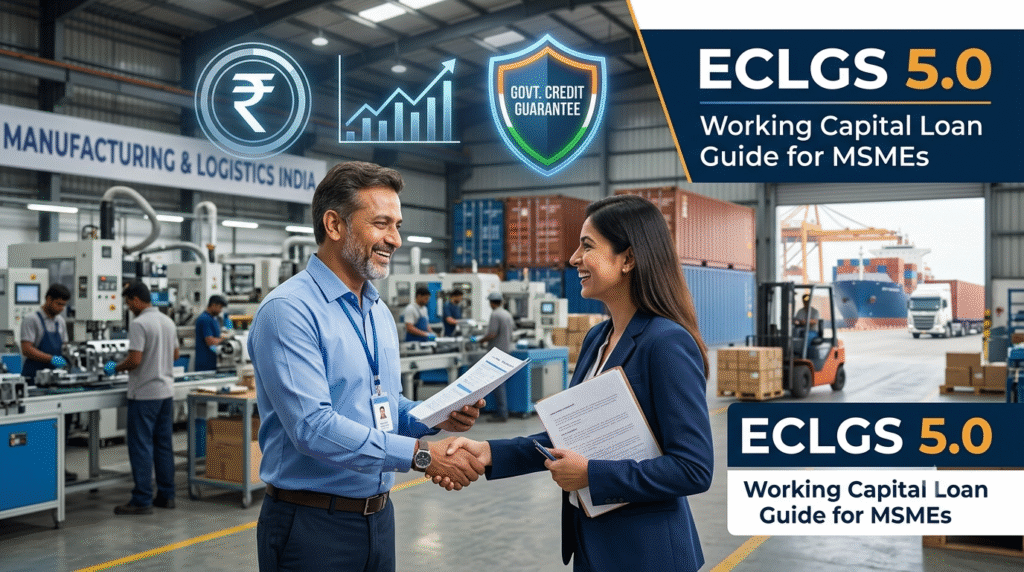
ECLGS 5.0 has become a major MSME credit story just months after its launch. The government approved the scheme in May 2026 with a ₹2.55 lakh crore target for additional credit, and by July 7, 4,11,497 guarantees worth ₹1,55,229 crore had already been issued. MSMEs accounted for 98% of the guarantees by number and 82% by guaranteed amount.
Now, a major development has raised questions for businesses that were depending on the scheme for additional working capital.
Business Standard reported on August 27, 2026 that the ₹2.55 lakh crore guarantee allocation had been exhausted and that ECLGS 5.0 had effectively ended after the guarantee ceiling was reached.
For MSMEs, however, the important question is not simply whether ECLGS 5.0 has ended.
The bigger questions are:
What happens if you already received an ECLGS 5.0 loan?
What if your loan was sanctioned but has not yet been disbursed?
And what should you do if you were planning to apply?
This updated guide explains the latest development, what is officially confirmed, what has been reported, and the practical steps MSMEs should take now.
🔴 LATEST ECLGS 5.0 UPDATE — AUGUST 30, 2026
ECLGS 5.0 was originally designed to operate until March 31, 2027 OR until the ₹2.55 lakh crore guarantee ceiling was reached, whichever came earlier.
The latest development is that Business Standard reported on August 27 that the ₹2.55 lakh crore guarantee allocation had been exhausted and that the scheme had been terminated.
Business Standard — ECLGS 5.0 guarantee allocation exhausted
ECLGS 5.0 ₹2.55 lakh crore guarantee allocation exhausted — Business Standard
This is particularly important for MSMEs with facilities that were sanctioned but not yet disbursed.
IMPORTANT: Do not assume that every pending ECLGS 5.0 loan has automatically been cancelled. Borrowers with pending sanctions should confirm the status of their guarantee and loan directly with their lender.
BusinessZindagi will update this article if an official clarification or further government announcement changes the position.
📌 Need Working Capital? Calculate Before You Borrow
Before applying for ECLGS 5.0, calculate how much working capital your business actually needs. Over-borrowing can increase financial stress, while under-borrowing may affect operations.
👉 Use BusinessZindagi Business Tools
What is ECLGS 5.0?
ECLGS 5.0 is the latest version of the Emergency Credit Line Guarantee Scheme, under which eligible businesses can obtain additional working capital from participating lenders. The Government provides a credit guarantee to the lender, encouraging banks and financial institutions to extend credit during periods of financial stress.
The scheme is intended to support businesses that remain operational but need temporary liquidity to continue production, purchase inventory, pay suppliers, or meet other working capital requirements.
Why Was ECLGS 5.0 Introduced?
The Government launched ECLGS 5.0 after the West Asia crisis disrupted international trade.
Many businesses experienced:
- Rising freight charges
- Supply chain disruptions
- Delayed exports and imports
- Higher inventory costs
- Working capital shortages
- Cash-flow pressure despite having customer orders
The scheme aims to reduce these liquidity challenges by making additional working capital available through eligible lenders.
The History of ECLGS: From COVID-19 Relief to Working Capital Support
Understanding the history of ECLGS helps explain why the Government continues to revive the scheme during major economic disruptions.
ECLGS 1.0 (2020)
Launched during the COVID-19 lockdown to help MSMEs survive one of the biggest business disruptions in recent history.
Main objective:
- Emergency working capital
- Salary payments
- Supplier payments
- Business continuity
ECLGS 2.0 (2020)
The Government expanded the scheme to include larger borrowers and more sectors affected by the pandemic.
Objective:
- Wider business coverage
- Continued liquidity support
ECLGS 3.0 (2021)
Focused on sectors that remained severely affected even after lockdown restrictions eased.
Included sectors such as:
- Tourism
- Hospitality
- Hotels
- Travel
- Aviation
- Leisure
Some eligible borrowers could access higher additional credit limits than under earlier versions.
ECLGS 4.0 (2021)
Introduced during India’s second COVID-19 wave.
Priority sectors included:
- Hospitals
- Nursing homes
- Oxygen generation plants
- Healthcare infrastructure
ECLGS 5.0 (2026)
Unlike earlier versions, ECLGS 5.0 is not a pandemic relief package.
It was introduced to help businesses affected by:
- West Asia geopolitical tensions
- Supply chain disruptions
- Increased logistics costs
- Working capital shortages
- Export and import disruptions
This marks the transition of ECLGS from pandemic support to a broader emergency liquidity tool for businesses facing extraordinary external shocks.
Who Should Consider Applying?
ECLGS 5.0 may be useful for businesses such as:
| Business Type | Should Consider? |
|---|---|
| Manufacturers | ✅ Yes |
| Exporters | ✅ Yes |
| Importers | ✅ Yes |
| MSMEs with working capital limits | ✅ Yes |
| Businesses facing temporary liquidity issues | ✅ Yes |
| Businesses with no genuine working capital requirement | ❌ Usually No |
📊 Improve Your Chances of Getting a Business Loan
Before applying for any working capital loan, make sure your business finances are well organized. Clean accounting records, GST compliance, and accurate financial statements can make the loan approval process smoother.
Key Benefits of ECLGS 5.0
- Additional working capital support
- Government-backed credit guarantee for eligible loans
- Helps maintain business continuity
- Supports exporters and manufacturers facing cash-flow pressure
- Encourages banks to lend during periods of economic uncertainty
How Much Additional Loan Can You Get?
The exact amount depends on the scheme guidelines and your existing banking relationship.
For many eligible MSMEs, the additional working capital can be up to 20% of the eligible peak fund-based working capital outstanding during the specified reference period, subject to scheme limits and lender assessment.
Example
Existing peak working capital:
₹50 lakh
Eligible additional credit:
Around ₹10 lakh
Your lender will determine the final sanctioned amount after verifying eligibility.
ECLGS 5.0 Is NOT Free Money
This is probably the biggest misconception.
Many business owners assume government schemes mean grants.
That is not true.
ECLGS 5.0 is:
- A loan
- Repayable
- Subject to lender approval
- Meant for genuine working capital needs
The Government guarantees the lender against eligible defaults under the scheme—it does not waive the borrower’s repayment obligation.
Who Should Avoid Taking This Loan?
Even though the scheme is attractive, it may not suit every business.
You should think carefully if:
- Your business has no stable cash flow.
- You are already struggling with existing EMIs.
- You don’t actually need additional working capital.
- The loan will not generate additional revenue.
Borrow only if it solves a genuine business problem.
Documents Generally Required
Although individual lenders may ask for additional documents, applicants should generally keep the following ready:
- PAN
- Aadhaar
- GST registration (if applicable)
- Udyam Registration
- Existing loan account details
- Bank statements
- Financial statements
- KYC documents
- Business proof
My Practical View
When I started my business, arranging working capital was one of the toughest challenges. Customer payments often came much later than supplier payments, creating pressure on cash flow. Timely access to working capital can help a business continue operations, especially when there are confirmed orders but temporary liquidity issues.
At the same time, every loan should be taken with a clear repayment plan. Additional borrowing only makes sense if it helps generate sustainable business income and strengthens your cash flow over time rather than increasing financial stress.
Frequently Asked Questions (FAQs)
Is ECLGS 5.0 available for new businesses?
Generally, the scheme is designed for eligible existing borrowers. Check the latest eligibility criteria with your lender.
Is collateral required?
The guarantee is provided under the scheme, but lending terms depend on the participating bank or financial institution.
Can exporters apply?
Eligible exporters meeting the scheme conditions may apply through participating lenders.
Is this a subsidy?
No. ECLGS 5.0 is a government-backed loan guarantee scheme, not a grant or subsidy.
Can NBFC customers apply?
Subject to the scheme rules and participation of the lender.
What is the last date?
Applications are currently permitted until 31 March 2027, or until the overall guarantee limit under the scheme is exhausted, whichever is earlier.
Important: The March 31, 2027 date should not be interpreted as a guaranteed application deadline. The official guidelines stated that ECLGS 5.0 would operate until March 31, 2027 OR until guarantees of ₹2.55 lakh crore were issued, whichever was earlier.
Therefore, reaching the ₹2.55 lakh crore ceiling could bring the scheme to an earlier end.
Final Thoughts
ECLGS 5.0 reflects how the Government has adapted the Emergency Credit Line Guarantee Scheme over time—from supporting businesses during the COVID-19 pandemic to helping them navigate new global economic disruptions.
For MSMEs, exporters, manufacturers, and businesses affected by rising logistics costs or delayed payments, the scheme can provide valuable working capital support. However, it should be viewed as a financial tool rather than free money. Evaluate your cash flow, repayment capacity, and business needs before applying.
📚 Related Guides You May Find Helpful
- How to Get a Collateral Free Working Capital Loan for Your MSME: Complete 2026 Guide
- India’s MSMEs May Finally Get Paid: How the TReDS portal Mandate Could Unlock ₹8.1 Lakh Crore
- Your Business Has a CIBIL Score Too — Here’s How to Improve it
- How CGTMSE Loan Helped My Small Business Grow Without Collateral: A very important scheme for New Entrepreneur
Editorial Note: This article is for educational and informational purposes only. Scheme features may change through government notifications or lender guidelines. Always verify the latest eligibility and terms with your bank before applying.
AI Disclosure
AI Disclosure: AI tools assisted in researching and structuring this article. The content has been reviewed and edited by the BusinessZindagi editorial team to improve accuracy and readability.
Affiliate Disclosure
Affiliate Disclosure: This article may contain affiliate links. If you purchase a product or service through these links, BusinessZindagi may earn a commission at no extra cost to you. This helps support our independent content.
1. PMO India – Cabinet approval of ECLGS 5.0
This is the primary source explaining why ECLGS 5.0 was introduced, its objectives, guarantee amount, eligibility, and the impact of the West Asia crisis.
Link:
Prime Minister’s Office – Cabinet approves ECLGS 5.0
2. Jan Samarth Portal (Official Application Portal)
Explains:
- Eligibility
- Documents
- Application process
- Participating banks
Link:
Jan Samarth – ECLGS 5.0 Scheme
3. National Credit Guarantee Trustee Company (NCGTC)
Explains the guarantee mechanism behind ECLGS.
Link:
National Credit Guarantee Trustee Company (NCGTC)
4. Ministry of Finance
Useful for future notifications and scheme amendments.
Link
Participating Banks
These pages explain practical implementation.
About the Author
Tabrez Khan is the founder of BusinessZindagi.com, where he shares practical insights on MSMEs, entrepreneurship, import-export, business finance, government schemes, and small business growth. As a first-generation entrepreneur and exporter from Assam, he combines real-world business experience with in-depth research to simplify complex business topics for entrepreneurs, traders, manufacturers, and startups across India. His goal is to help business owners make informed decisions through practical, easy-to-understand, and trustworthy content.